
Wildlife-Friendly Agriculture Practices Training Course
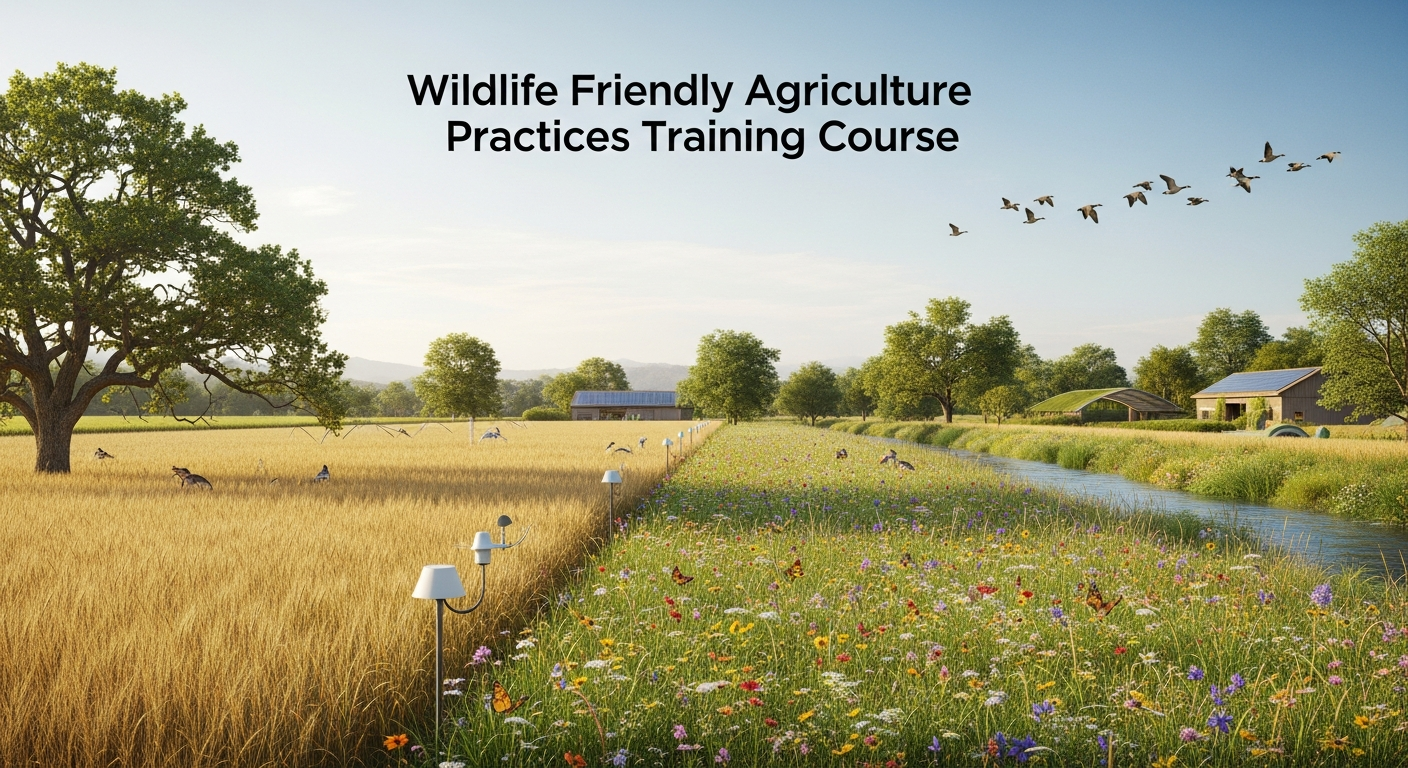
Course Title: Wildlife-Friendly Agriculture Practices Training Course
Executive Summary
This two-week intensive training course addresses the critical intersection between agricultural productivity and biodiversity conservation. As agricultural expansion remains the primary driver of habitat loss, this program equips participants with practical tools and strategies to implement wildlife-friendly farming systems. Through a blend of ecological theory, conflict mitigation techniques, and market-based incentive structures, participants will learn how to maintain yields while restoring ecosystem services. The course covers regenerative agricultural practices, human-wildlife conflict (HWC) management, and the establishment of wildlife corridors within working landscapes. It specifically targets the integration of conservation science with agronomy to foster coexistence. By analyzing global case studies and engaging in field-based scenarios, attendees will gain the expertise to design landscape-level interventions that enhance rural livelihoods, ensure food security, and protect vital wildlife populations. Graduates will emerge as change agents capable of bridging the divide between production and conservation sectors.
Introduction
In an era of accelerating biodiversity loss and climate change, the traditional dichotomy between agriculture and conservation is no longer sustainable. Agriculture occupies a vast portion of the Earth’s habitable land, making it the most significant operational environment for wildlife outside of protected areas. The ‘Wildlife-Friendly Agriculture Practices Training Course’ is designed to transform how agricultural professionals, conservationists, and policymakers approach land management. It advocates for a shift from segregation to integration, promoting landscapes where farming and wildlife can flourish together.The course explores the principles of agroecology and landscape connectivity, emphasizing that farm health is intrinsically linked to ecosystem health. Participants will delve into complex challenges such as Human-Wildlife Conflict (HWC), which threatens both farmer livelihoods and endangered species. The curriculum moves beyond theory, offering robust frameworks for non-lethal deterrents, habitat restoration, and the economic valuation of ecosystem services. Furthermore, it addresses the growing consumer demand for ethical products, guiding participants through certification schemes and value-chain innovations that reward stewardship.Over ten comprehensive modules, learners will engage with expert-led content ranging from soil microbiology to international policy frameworks. They will utilize systems thinking to solve problems involving crop raiding, pollinator decline, and watershed degradation. By the end of this program, professionals will possess a holistic understanding of how to manage agricultural systems that support biodiversity, thereby ensuring long-term resilience for both nature and farming communities. This course ultimately aims to operationalize the concept of coexistence, turning potential conflict zones into models of sustainable development.
Course Outcomes
- Design and implement agricultural systems that support local biodiversity and ecosystem services.
- Apply non-lethal mitigation strategies to resolve human-wildlife conflicts effectively.
- Develop landscape-level management plans incorporating wildlife corridors and buffer zones.
- Utilize regenerative soil and water conservation techniques to enhance habitat quality.
- Navigate certification standards and markets for wildlife-friendly agricultural products.
- Conduct biodiversity monitoring and impact assessments on agricultural lands.
- Formulate policies and governance structures that incentivize conservation agriculture.
Training Methodologies
- Interactive lectures on agro-ecological principles and wildlife behavior.
- Field visits to model farms and wildlife-interface zones.
- Geospatial mapping exercises for landscape planning.
- Role-playing simulations for human-wildlife conflict resolution.
- Case study analysis of successful coexistence projects.
- Practical workshops on deploying non-lethal deterrent technologies.
- Peer-to-peer learning and multi-stakeholder dialogue sessions.
Benefits to Participants
- Acquisition of specialized skills in bridging agriculture and conservation.
- Enhanced capability to manage complex land-use conflicts.
- Access to a global network of practitioners in eco-agriculture.
- Practical knowledge of biodiversity monitoring tools and metrics.
- Understanding of premium market access through sustainability certifications.
- Improved strategic planning abilities for landscape management.
- Professional certification in wildlife-friendly land management.
Benefits to Sending Organization
- Improved institutional capacity to address environmental compliance and sustainability goals.
- Reduction in costs associated with human-wildlife conflict and crop loss.
- Enhanced reputation and credibility in environmental stewardship.
- Access to green financing and international conservation funding.
- Strengthened community relations through effective conflict mitigation.
- Alignment with national biodiversity strategies and SDGs.
- Long-term resource security through regenerative ecosystem management.
Target Participants
- Agricultural Extension Officers and Agronomists.
- Conservation NGO Managers and Field Officers.
- Land Use Planners and Zoning Authorities.
- Wildlife Management Authority Officials.
- Agribusiness Sustainability Managers.
- Environmental Policy Analysts.
- Community Resource Board Leaders.
WEEK 1: Foundations of Coexistence and Habitat Management
Module 1 – Principles of Wildlife-Friendly Farming
- Introduction to agroecology and biodiversity functions.
- The business case for wildlife-friendly agriculture.
- Understanding ecosystem services: pest control, pollination, and soil health.
- Historical context of agriculture-conservation relationships.
- Mapping the farm within the wider ecosystem.
- Identifying key wildlife species and their habitat requirements.
- Case study: Integrated farming systems in high-biodiversity zones.
Module 2 – Landscape Management and Connectivity
- Concepts of habitat fragmentation and edge effects.
- Designing effective wildlife corridors and stepping stones.
- Management of riparian zones and hedgerows.
- Buffer zone establishment around protected areas.
- Fencing strategies: Wildlife-permeable vs. exclusion fencing.
- Land-sharing vs. Land-sparing debates.
- GIS tools for landscape connectivity planning.
Module 3 – Human-Wildlife Conflict (HWC) Mitigation
- Drivers and typologies of human-wildlife conflict.
- Behavioral ecology of crop-raiding species.
- Non-lethal deterrents: Bio-fences, acoustics, and lights.
- Early warning systems and community surveillance.
- Livestock protection: Predator-proof enclosures and herding.
- Compensation and insurance schemes for wildlife damage.
- Simulation: Managing a crop-raiding elephant scenario.
Module 4 – Soil, Water, and Habitat Health
- Regenerative agriculture practices for soil restoration.
- Minimizing chemical inputs: Integrated Pest Management (IPM).
- Water resource management for shared use.
- Impact of agrochemicals on non-target wildlife.
- Cover cropping and crop rotation for biodiversity.
- Restoring native vegetation on marginal lands.
- Practical: Assessing soil health and biodiversity indicators.
Module 5 – Supporting Pollinators and Beneficial Insects
- The critical role of pollinators in food security.
- Habitat requirements for wild bees and other insects.
- Designing floral strips and beetle banks.
- Reducing pesticide risk to pollinators.
- Biological control of pests using natural predators.
- Monitoring pollinator populations.
- Workshop: Building insect hotels and pollinator habitats.
WEEK 2: Markets, Policy, and Strategic Implementation
Module 6 – Certification, Branding, and Market Incentives
- Overview of eco-labels: Organic, Rainforest Alliance, Predator-Friendly.
- Requirements for wildlife-friendly certifications.
- Value chain analysis for conservation-grade products.
- Marketing strategies for ethical consumers.
- Payment for Ecosystem Services (PES) models.
- Carbon markets and agroforestry opportunities.
- Case study: Successful branding of wildlife-friendly coffee/cocoa.
Module 7 – Biodiversity Monitoring and Evaluation
- Establishing baselines for on-farm biodiversity.
- Low-cost monitoring techniques: Camera traps and transects.
- Citizen science and community-based monitoring.
- Using bio-indicators to assess environmental health.
- Data management and reporting for stakeholders.
- Evaluating the effectiveness of mitigation interventions.
- Field exercise: Setting up a biodiversity monitoring transect.
Module 8 – Socio-Economic and Community Dimensions
- Livelihood diversification: Ecotourism and agro-tourism.
- Gender roles in agriculture and conservation.
- Indigenous knowledge systems in land management.
- Conflict resolution negotiation skills.
- Building community conservancies and cooperatives.
- Social impact assessment of conservation rules.
- Group discussion: Balancing profitability with stewardship.
Module 9 – Policy, Legislation, and Governance
- National and international wildlife laws affecting agriculture.
- Land tenure rights and stewardship agreements.
- Subsidies and policy incentives for green farming.
- Cross-sectoral coordination (Agriculture vs. Environment Ministries).
- Legal frameworks for HWC management.
- Advocacy for policy reform.
- Review: Analysis of local agricultural acts.
Module 10 – Action Planning and Future Strategies
- Climate change adaptation in eco-agriculture.
- Synthesizing course learnings into a coherent strategy.
- Project cycle management for conservation agriculture.
- Resource mobilization and grant writing basics.
- Drafting institutional action plans.
- Building partnerships for implementation.
- Capstone presentation: Participants’ strategic roadmaps.
Action Plan for Implementation
- Conduct a baseline biodiversity and conflict assessment in the target area within 30 days.
- Map critical wildlife corridors and high-risk conflict zones.
- Select and pilot three specific wildlife-friendly interventions (e.g., bio-fences, IPM).
- Engage local community stakeholders to form a coexistence committee.
- Develop a monitoring framework with clear indicators for success.
- Identify and apply for relevant certification or market opportunities.
- Schedule quarterly reviews to adapt strategies based on monitoring data.
Course Features
- Lecture 0
- Quiz 0
- Skill level All levels
- Students 0
- Certificate No
- Assessments Self

You May Like

Advanced Population Ecology and Demographics
Course Title: Advanced Population Ecology and Demographics Executive Summary This intensive two-week course on Advanced Population Ecology and Demographics equips participants with advanced quantitative and...

Applied Conservation Genetics for Species Management
Course Title: Applied Conservation Genetics for Species Management Executive Summary This two-week intensive course on Applied Conservation Genetics for Species Management bridges the gap between...

Threatened Species Recovery and Reintroduction Programs
Course Title: Threatened Species Recovery and Reintroduction Programs Executive Summary This intensive two-week course provides a comprehensive framework for designing, implementing, and managing recovery plans...

Landscape Ecology and Connectivity Science Training Course
Course Title: Landscape Ecology and Connectivity Science Training Course Executive Summary This intensive two-week executive course on Landscape Ecology and Connectivity Science is designed to...

Biodiversity Hotspot Conservation and Management
Course Title: Biodiversity Hotspot Conservation and Management Executive Summary This intensive two-week course on Biodiversity Hotspot Conservation and Management equips participants with the knowledge and...




